

Cloud engineering is the practice of designing, building, and running the infrastructure and systems that power applications in the cloud. A cloud engineer uses tools like Amazon Web Services (AWS), Linux, Docker, and Terraform to make sure software runs reliably, securely, and at scale on cloud platforms instead of on local servers.
Key Takeaways
- Cloud engineering is about building and maintaining the cloud infrastructure that applications run on, using platforms like AWS and tools like Linux, Docker, and Terraform.
- It is a hands-on, high-demand career: cloud engineers in Germany earn roughly €45,000 to €58,000 at entry level and €85,000 or more with experience.
- You do not need a university degree to start. Practical skills, recognised certifications, and real projects matter most.

Table of Contents
What does a cloud engineer do?
A cloud engineer builds and maintains the systems that let companies run their software on cloud platforms instead of their own hardware. Day to day, that means setting up servers and networks in the cloud, automating how applications are deployed, keeping systems secure, and making sure everything keeps running when traffic grows.
In practice, the work centres on a recognisable set of tools and tasks:
- Cloud platforms. Most work happens on a major provider, most commonly AWS, where the engineer provisions and manages computing, storage, and networking.
- Linux and the command line. The operating system that most cloud servers run on, and the everyday environment of a cloud engineer.
- Containers and orchestration. Tools like Docker package applications so they run the same way everywhere, while orchestration systems like Kubernetes manage them at scale.
- Infrastructure as code. With tools like Terraform, engineers define entire environments in code, so infrastructure can be built, repeated, and changed reliably.
- Automation and CI/CD. Continuous integration and delivery pipelines automate testing and deployment, so new versions of software ship quickly and safely.
- Monitoring and security. Keeping an eye on performance, controlling access, and protecting data are part of the daily job.
The common thread is automation and reliability. A good cloud engineer makes complex systems run smoothly without constant manual work.
Cloud engineering vs cloud computing
People often use these terms interchangeably, but they describe different things. Cloud computing is the broad concept of delivering computing services, such as servers, storage, and databases, over the internet. Cloud engineering is the hands-on discipline of actually building and running those systems.
| Cloud computing | Cloud engineering | |
|---|---|---|
| What it is | The concept of delivering computing over the internet | The hands-on work of building and running cloud systems |
| Focus | Using cloud services | Designing, automating, and maintaining them |
| Typical roles | Cloud user, analyst, administrator | Cloud, DevOps, and platform engineers |
Put simply, cloud computing is the what, and cloud engineering is the how. If you are deciding which path or course fits you, we break the two down in detail in our guide to cloud computing vs cloud engineering.
What skills do you need?
To become a cloud engineer, you need a mix of platform knowledge, automation skills, and recognised certifications. The good news is that this is a field where practical ability counts more than formal academic background.
The core skills are:
- A cloud platform, most commonly AWS, including its core compute, storage, networking, and security services.
- Linux, since the majority of cloud infrastructure runs on it.
- A scripting language, usually Python, for automation and operational tasks.
- Networking and security fundamentals, so systems are connected and protected correctly.
- Containers and infrastructure as code, meaning Docker, Kubernetes, and Terraform.
- CI/CD and automation, to deploy software reliably and repeatedly.
Certifications matter in this field because they give employers a clear, verifiable signal. The most valued starting points are the AWS Certified Cloud Practitioner and, a step up, the AWS Certified Solutions Architect – Associate. A Linux certification rounds out a strong entry-level profile, and as more cloud roles now involve AI, the AWS Certified AI Practitioner is fast becoming a valuable addition.

Career paths and demand
Cloud engineering is one of the most in-demand areas in tech, driven by a clear shortage of qualified professionals as companies move more of their operations to the cloud. Demand is strong across nearly every industry with a meaningful digital presence, from finance and manufacturing to e-commerce and healthcare.
Typical entry roles include Cloud Support Engineer and Cloud Operations Engineer, which then open paths toward Cloud Engineer, DevOps Engineer, and Cloud Architect. The pay reflects the demand. In Germany, entry-level cloud roles generally pay around €45,000 to €58,000, the average sits near €65,000 to €70,000, and senior cloud engineers earn €85,000 or more, with top earners well above €100,000 (Glassdoor and jobvector, 2026). Figures vary by source, region, and specialisation, so treat them as ranges.
There is also a bigger trend behind the demand. Cloud is the foundation that modern AI is built on, since training and running AI systems depends on scalable cloud infrastructure. As AI adoption grows, so does the need for engineers who can build and operate the platforms underneath it.
How to get started
You do not need a computer science degree to become a cloud engineer. The most reliable route is a structured, hands-on programme that takes you from the fundamentals to real, deployable projects and recognised certifications.
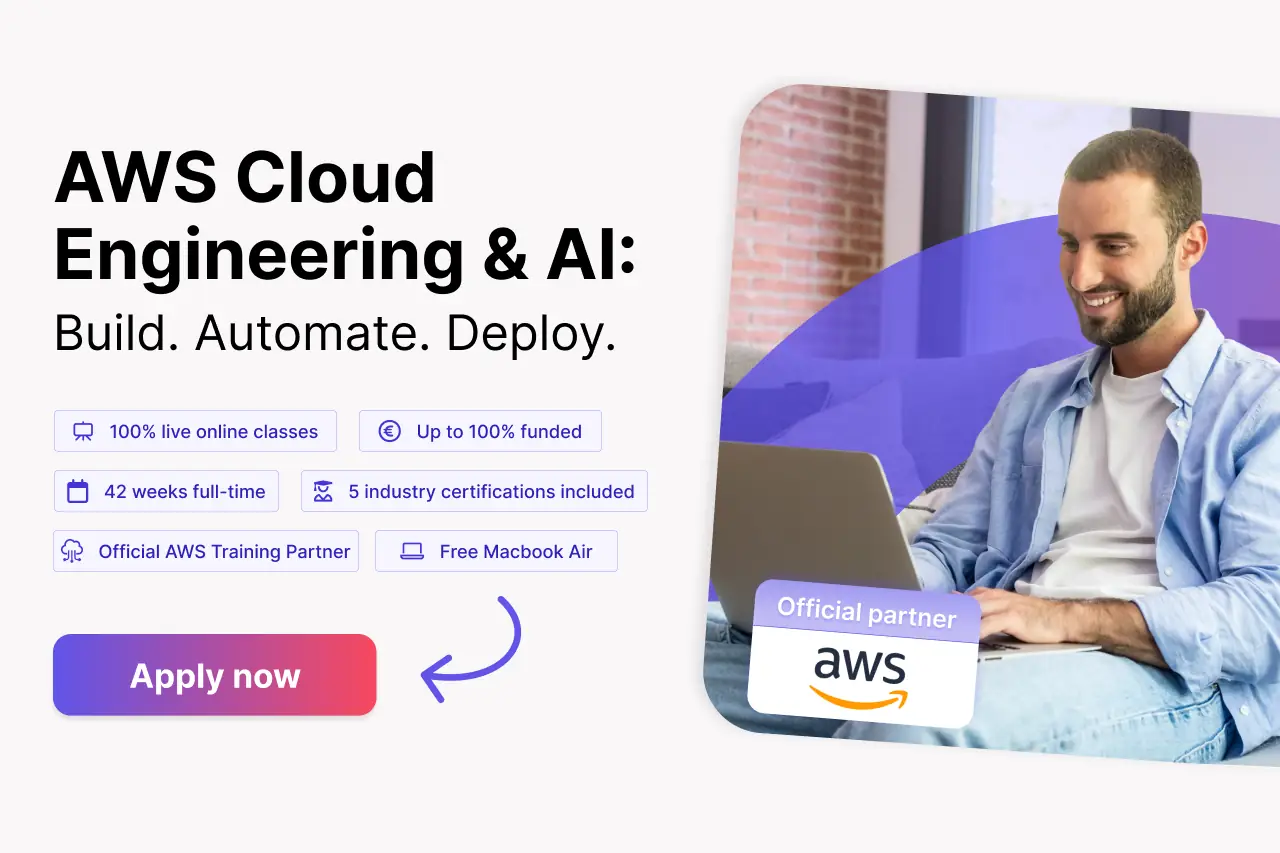
As an AWS Partner, WBS CODING SCHOOL builds its AWS Cloud Engineering & AI Course around official AWS curriculum and certifications. It is a 42-week, full-time, fully remote, instructor-led programme that takes beginners and career changers from cloud foundations through to advanced cloud engineering, including Linux, Python, AWS architecture, Docker, Kubernetes, Terraform, CI/CD, AI-assisted coding with Claude Code, applied AI on AWS, and a large final project. Along the way you earn industry certifications: Linux Essentials, the AWS Certified Cloud Practitioner, and the AWS Certified AI Practitioner are completed during the Course, with the PCEP and AWS Certified Solutions Architect – Associate available after graduation (five certifications in total). You also keep the MacBook Air after you graduate.
Depending on your situation, training like this can be funded through a Bildungsgutschein, an education voucher from the Agentur für Arbeit that can cover course costs for eligible jobseekers. If a fully remote, certification-focused route into cloud sounds right for you, the AWS Cloud Engineering & AI Course is a practical place to begin.
Frequently asked questions
What is cloud engineering in simple terms?
Cloud engineering is building and running the systems that let applications work in the cloud. Instead of a company buying and maintaining its own servers, a cloud engineer sets up that infrastructure on a platform like AWS, automates it, secures it, and makes sure it scales. It combines system administration, automation, and software practices into one role.
Is cloud engineering hard to learn?
Cloud engineering is challenging but very learnable, especially with a structured path. You do not need to master everything at once: most people start with the fundamentals, Linux, a cloud platform like AWS, and basic scripting, then build up to containers, automation and infrastructure as code. With a guided, hands-on course and real projects, career changers with no prior cloud experience regularly reach a job-ready level in under a year.
Do you need a degree to become a cloud engineer?
No. You do not need a university degree to become a cloud engineer. Employers in this field hire based on practical skills, recognised certifications such as the AWS Certified Cloud Practitioner and Solutions Architect, and real projects you can show. A structured course and a strong portfolio can get you to job-ready faster than a degree.
What is the difference between cloud computing and cloud engineering?
Cloud computing is the broad concept of delivering computing services over the internet, while cloud engineering is the hands-on work of building and running those systems. Cloud computing is the what; cloud engineering is the how. Most cloud engineers work day to day with platforms like AWS and tools like Linux, Docker, and Terraform.
How long does it take to become a cloud engineer?
With a structured, full-time route, you can reach an entry-ready level in under a year. Self-taught paths vary widely and often take longer, because they lack a fixed curriculum and deadlines. What matters most to employers is the combination of recognised certifications, such as the AWS Certified Cloud Practitioner, and real, deployable projects you can show.