
Key takeaways
- Victoria moved from Kyiv to Germany in 2022 and retrained through a Data Science & AI Course after years in e-commerce, SEO, and revenue management.
- Her course included a two-month internship at DocMorris, where she built an LLM-based pharmacy AI agent and worked with forecasting and data pipelines.
- She now works as a Junior AI & E-Commerce Manager, combining her commercial background with new data and AI skills.
Table of Contents
Who is Victoria?
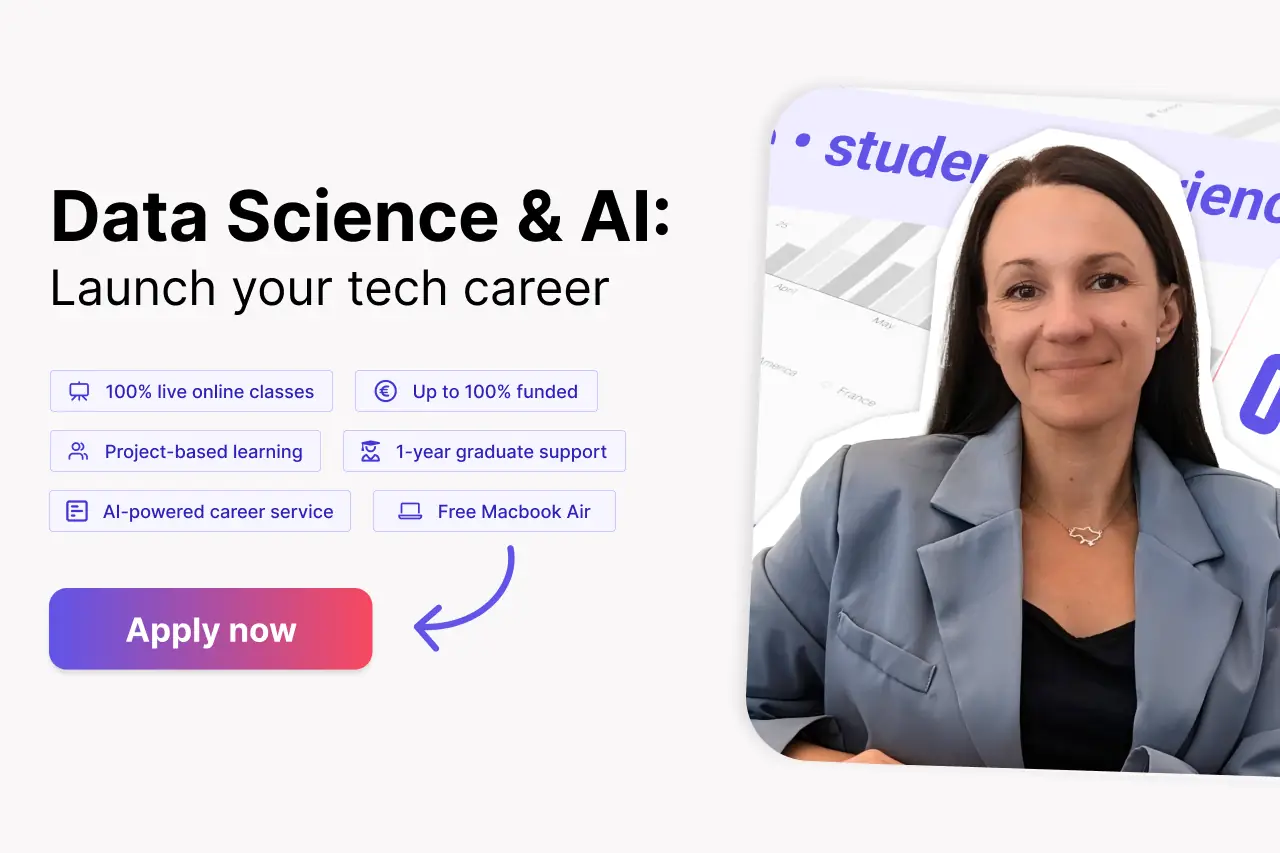
Victoria is a Data Science & AI graduate from Kyiv, Ukraine, who rebuilt her career in Germany. Her working life has always revolved around data: first in revenue management at an airline, then in e-commerce and SEO.
Today she works as a Junior AI & E-Commerce Manager at Hanse Home Collection GmbH. In her own words: “I’m originally from Kyiv, Ukraine. My professional background has always been closely connected to data.”
Between those two points sit a full-time Data Science & AI Course and a hands-on internship at DocMorris, one of the partner companies WBS CODING SCHOOL works with.
Rebuilding a career in Germany after leaving Ukraine
Victoria came to Germany in 2022, when the war forced her to leave. Starting again meant more than a new job. It meant a new country, a new language, and a new professional identity.
“I moved to Germany because of the war in Ukraine. Like many Ukrainians, I had to leave a life and career that I had built over many years and start again in a completely new environment.”
Her first months were about finding stability and understanding how things work in Germany. She had a strong professional background, but she knew that continuing exactly where she had left off in Ukraine would not automatically translate.
Why choose a structured Data Science & AI Course over self-teaching
Data had been part of Victoria’s work for years, from analyzing performance to spotting patterns and making decisions based on numbers. What changed was her ambition: she wanted to build, not just use.
“I didn’t just want to use data as part of my work. I wanted to understand the technology behind it and be able to build things myself.”
She chose a structured training rather than piecing skills together alone. She wanted a systematic foundation, guided fundamentals, real projects, and a bridge into the German job market. A longer format gave her time to move past watching lessons and start building a portfolio.
This is a common starting point for anyone weighing a career change to data science: the question is rarely whether the field is interesting, but how to build credibility fast.
Inside the Data Science & AI Course: from first weeks to final project
The Data Science & AI Course runs full-time over several months, and the journey changes shape as it goes. Early on, there is a lot to absorb: new terminology, new concepts, and the core tools of the field.
“Gradually, things started connecting. Instead of learning individual technologies separately, I began to understand how they fit together in a real Data Science workflow,” Victoria says. That workflow runs from understanding a problem to working with data, building a model, evaluating results, and communicating what she found.
The later weeks moved into machine learning and deep learning, and Victoria found the mix of programming, statistics, and AI applications the most interesting part of the field.
The turning point came with her group’s final project, SolarSight, an application that uses satellite imagery, data, and machine learning to identify suitable rooftops for solar panels. “That was when I thought, I can actually do this,” she recalls.
“I learned that you don’t have to know everything yourself to build something meaningful. You need to contribute your skills, communicate, and solve problems together.”
She also found that a non-traditional background was an asset. “You don’t have to fit the traditional profile of a Data Scientist to enter the field. Your previous experience can actually become an advantage if you learn how to combine it with your new technical skills.”

The DocMorris internship: from classroom to real-world data work
The course leads into an internship, and Victoria did hers at DocMorris as a Data Scientist Intern. It was the bridge between learning and employment, and it looked very different from coursework.
“In a course, you usually know what the task is and what technologies you are expected to use. In a real company, the problems are much less clearly defined,” she says. First came the business context, the existing systems, the data, and the processes, then the decision about the right solution.
Her work spanned several areas. One main project was an LLM-based Pharmacy Assistance AI Agent built with LangGraph, exploring how an AI agent could support pharmacy-related workflows. She also worked with Langfuse for monitoring and compliance, used Snowflake and SQL for data tasks, and gained experience with forecasting in Prophet and orchestration in Airflow.
“What was particularly valuable was seeing how these technologies are used together in a real production-oriented environment rather than as isolated exercises,” she says. If you want to see how another graduate approached a similar path, read about a data science internship in Germany.
Her biggest takeaway: technical skill is one part of the job. “You also need to understand the business problem, communicate with other people, and work within real-world constraints.”
Landing a role in AI and e-commerce
Victoria now works as a Junior AI & E-Commerce Manager, a role that ties her past and present together. She did not want to erase her earlier career; she wanted to build on it.
“It feels like the different parts of my career have finally come together,” she says. She combines her understanding of e-commerce and SEO with programming, data analysis, and AI.
The course, projects, and internship gave her something concrete to show. “Instead of saying ‘I want to work in AI,’ I could show what I had actually built and what I had already worked on in a professional environment.”
Victoria’s advice for career changers and internationals
Victoria’s first piece of advice is to value what you already carry. “Don’t underestimate what you already bring with you,” she says. A previous career does not disappear when you switch fields; it can become the thing that sets your profile apart.
Her second point is about learning by doing. She recommends a path that leaves time to build real projects, because solving problems yourself is where the learning happens.
“Don’t wait until you feel completely ready. You probably never will. At some point, you have to start applying what you know and learn the rest along the way.”
Data science career change FAQ
Can you move into data science without a technical background?
Yes, you can move into data science without a technical background. Victoria came from e-commerce, SEO, and revenue management, and built her technical skills from the ground up during a Data Science & AI Course. A business or analytical background often helps, because it makes it easier to connect data work to real decisions.
Do you need to speak German to change careers into tech in Germany?
You do not need fluent German to start a tech career in Germany. Most WBS CODING SCHOOL courses are available in English, and much of the tech industry works in English day to day. Learning German still helps for daily life and widens your options over time.
Related blogs
- A data science internship in Germany
- How René pivoted from audio to a tech internship at DocMorris
- Career change to data science
Conclusion
Victoria’s story shows what a data science career change can look like when you build on what you already know. She moved countries, learned a new field, and turned an internship into a role that blends e-commerce with AI. Her path started with a structured course and the time to practice it. WBS CODING SCHOOL’s Data Science & AI Course includes a hands-on internship and is fundable via Bildungsgutschein, a concrete next step if you are ready to make the switch.