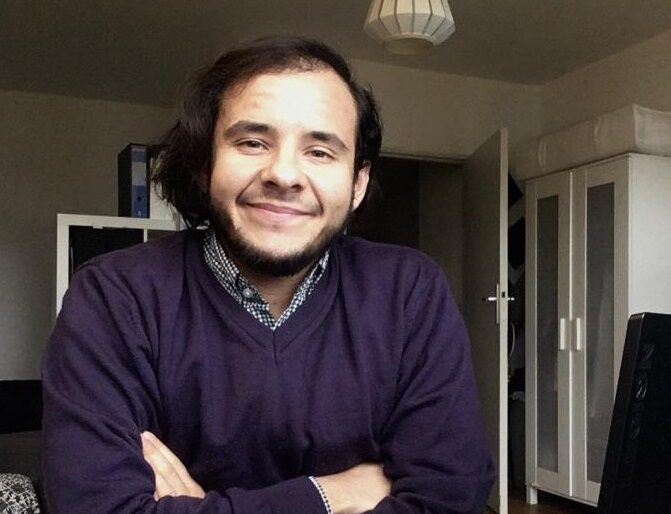
As a dazzling Berlin spring danced around him, Holden Madagame sat in his small rented room and watched the year 2020 slowly tear his life to pieces. A professional opera singer from Michigan, he had seen all three of his upcoming singing gigs cancelled in the wake of the Covid-19 global pandemic. He’d fallen back to teaching English freelance, only to have all of his students call off their courses in the space of the same week, leaving him with only just enough income to cover rent.
“That was the moment when I knew that I had to do something else with my life,” he tells me, when I reach out to interview him.
Even at the time, Holden was certainly no stranger to radical change. A committed trans activist, six years prior he had flown to Bangkok for top-surgery, and in the process switched professionally from mezzo soprano to tenor – a transformation with virtually no history even in the protean world of opera. This time, though, he wasn’t planning on modifying his body: he was going to repurpose his mind.
Holden Madagame was going to turn from a tenor into a qualified computer programmer – and he was going to complete that journey in less than four months.
“To be honest, at first I worried that I wasn’t smart enough. I didn’t think I had the right logical or mathematical predisposition. People actually told me to my face that I couldn’t do it if I didn’t pass this or that aptitude test. There’s this narrative going on that only specially talented people can learn coding, but what I learned was that it’s just not true.”
Of the myriad resources available to start learning, it was ultimately our Full-Stack Web & App Development Course that convinced him. “It covered every topic I was looking for. And the hybrid structure was perfect: I could combine the comfort of studying from home with the practical benefits of working on site and in person.”
Holden graduated in September 2020. I was personally present at the Demo Day, sitting in the audience as he and his project partner Julia Jannsen presented their creation Lola, a fully functional app designed to assist users with language learning. But for his confidence on the stage, you would never have guessed that this young programmer had been singing in operas when the brown leaves outside the windows of our campus were still green.

We at WBS Coding School are always very excited to see our students learn about tech. In Holden’s case, there is perhaps more to be said about what the world of tech can learn from him.
“A lot of people in this industry want to be more open and inclusive to trans people, but they don’t know how – they simply don’t have the language for it. Compared to opera, tech comes from a background that is much less communicative, and conversations on diversity tend to be tokenized – people will say, ‘let’s hire a trans person’ and think the question of inclusivity is solved, when in fact it goes much deeper than that. You have to think critically of the environment as a whole. Personally, and based purely on what I’ve seen so far, I still don’t feel that I can totally be myself in tech environments.”
Even so, Holden is anything but intimidated. “I am excited to see how I fit into the tech industry and how people will communicate with me,” he says with a smile. “I haven’t just gained a new skill with this course. My sense of self-respect, my self-worth, my understanding of my own needs and boundaries, are all definitely higher. Yes, I am excited!”
We’re excited for you too, Holden. You learned to change, and then never stopped changing, and on these grounds alone you have already made us proud.